
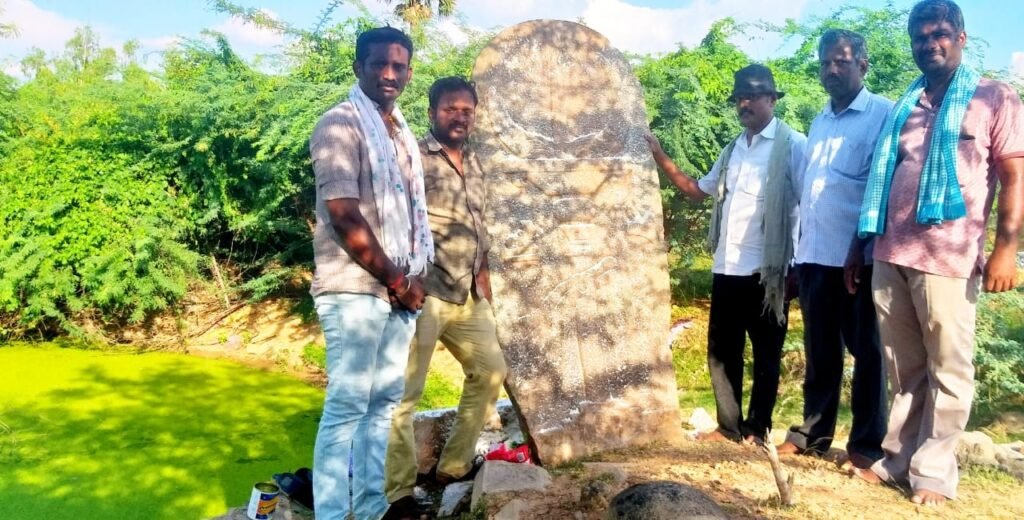
Chola-Era Inscription of “Varaguna Irukkuvel” Revealing Temple Land Donation and Water Tank Construction Discovered in Sithuppatti
A rare 10th-century stone inscription dating back to the reign of Parantaka Chola – I has been discovered at Sithuppatti village in the Iluppur taluk of Pudukottai district.
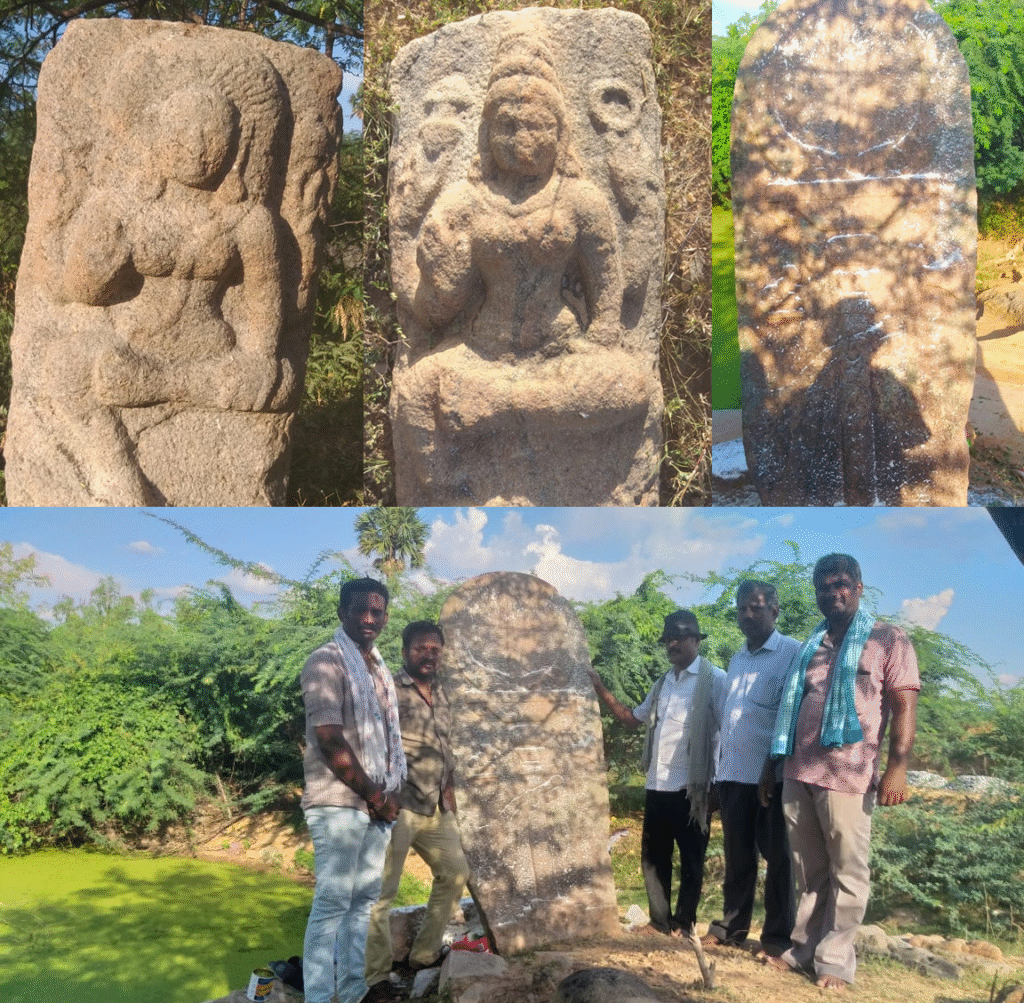
The inscription records that Varaguna Irukkuvel, the Kodumbalur chieftain, donated land to a temple and established a water tank during the Chola period.
The inscription is carved on a large trident stone (Soolakkal) located near the Sithuppatti village water tank. Measuring 8.5 feet in height and 3 feet in width, one side bears the inscription, while the other features a beautifully carved trident emblem (Soolam). The trident symbolizes land donated to deities and represents the Shaiva art and religious tradition of the Chola period. This is considered one of the largest trident-inscribed stones found so far in Tamil Nadu.
According to Manganur Manikandan, founder of the Pudukottai Archaeological Research Forum
“In 2017, archaeology enthusiasts M. Murugaprasad team reported the existence of this inscription. Following this discovery we continued our research under the guidance of the forum president, Karu. Rajendran. Though the inscription was partially damaged, it was recently re-examined and deciphered with the assistance of the Archaeological Survey of India (ASI) team led by epigraphist Mr. Balamurugan, confirming our initial readings,” he said.
Details of the Inscription:
The text begins with the royal title “Kopperakesari” (a title used by Parantaka Chola) and continues to describe:
“I granted land in Velkadai Iswaram to Lord Mahadeva as Devadana (temple endowment).
With the consent of Varaguna Irukkuvel, the water tank of Sirrur was excavated and offered…
As per the order from Annal Vayil region under Keezh Konadu, the villagers together executed the work and consecrated the site.”
This confirms that Varaguna Irukkuvel, the Kodumbalur chieftain, under the reign of Parantaka Chola (Kopperakesari), donated land to vel Kaadai Eswarathu Mahadeva temple and constructed a water tank for the benefit of the community.
The reference to “Annal Vayil Kuttram under Keezh Konadu” reveals the administrative divisions of the period and the involvement of village assemblies in managing temple and public infrastructure. The inscription is significant evidence of the close interlink between religion, land grants, water management, and local governance during the Chola era.
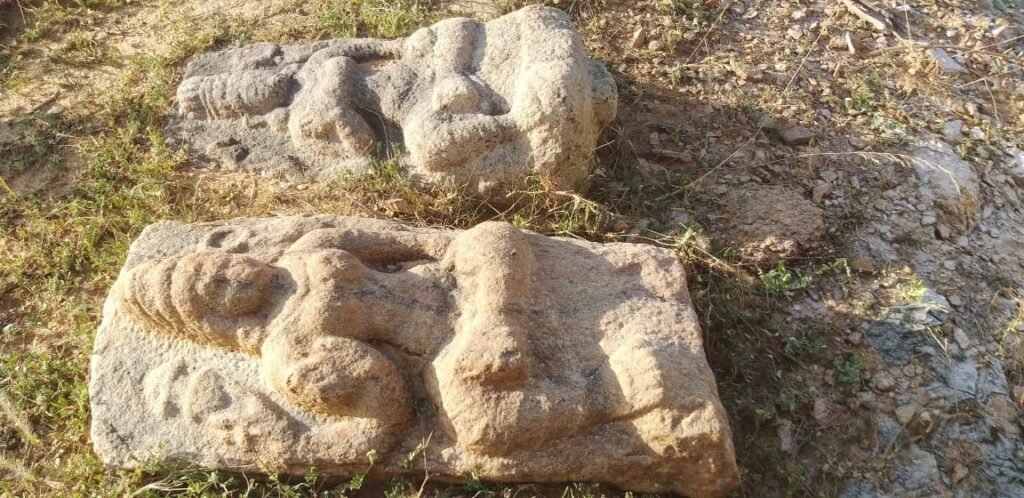
Additionally, the site also contains fragments of inscriptions attributed to Rajendra Chola I (noted as “Iratta Paadi Konda Cholan”), along with ancient sculptures of Nagaraja, Durga, Sapta Kanyas, and Chandikeswara, indicating the existence of a once-flourishing temple complex.
This discovery provides valuable insights into the Shaiva tradition and temple-centered administrative system of the Chola period in the Pudukottai region.


Why people still use to read news papers when in this technological globe all is accessible on net?